Wednesday, August 15, 2018

Does a "Hidden Hand" guide Garland bond-issue talk? Don't ignore blunt warnings about your property taxes increasing.

A "Why Now?" slide is shown at the community meeting at the North Garland Branch Library.
A few years back, a freshman Garland councilmember sat in our living room, querying my wife and me about whether we had perceived that a "Hidden Hand" might be responsible for some puzzling developments this newcomer had observed in our city government.

While Garland operates under a city-manager form of government with mayor and city council as somewhat titular heads, this new councilmember believed someone or something other than the city manager—and not easily identifiable—was behind certain patterns of making "these things happen" in our beloved city.

During his short tenure, this councilmember had already noticed that things just sort of seemed to "occur"—issues being presented as  "givens" without council action. For example, a choice of four possible outcomes regarding the downtown commercial area mysteriously and suddenly were narrowed down to just two. Who narrowed them down? Not council, he contended and we had observed. But who? That question was never answered.

Kay and I had seen enough in our nearly two decades living here to agree with him. What, or who, was this "Hidden Hand" guiding the city? we all three wondered.

Each of us had names and/or processes for what or who we suspected might be in control of these events in our city. Our names of the suspects, however, were not always the same.

To help affirm his perception, with this new city councilmember Kay and I reviewed Kay's verbatim transcripts of at least two earlier council work sessions where we could trace the exact "Hidden Hand" pattern he described. In sessions designed just for brainstorming, council would discuss some proposal. Suddenly, TA-DA! The "brainstorm" quickly and mysteriously got set in stone. How? No vote was ever taken (unless it was done so behind the scenes, which, of course, is not legal). No direct verbal order was agreed to on camera.

Fast-forward just a few years from that discussion, and the same pattern seems to be emerging again regarding discussions about a potential upcoming citywide bond issue.

The players that we all three perceived might be at work in this mysterious process two years ago are now no longer around, but the process continues. Hmm . . .. Did new faces take their places in the frames and adopt the old methods? Or where these odd decisions just the way Garland works?

If you listen to some of the rhetoric going on now, you hear a bond issue stated as a fact, a given. It's going to happen. One councilmember last week asked some citizens, "Are you aware we have a bond election coming up?"
Poll taken at a meeting to ascertain interest in having a bond election. Voting is on the "honor" system, presuming that non-Garland citizens will refrain from participating.
But who said so? And when exactly was that decision made? Council hasn't voted this in as gospel.  At its un-televised day-long retreat at a Garland hotel in mid-December City Council by consensus agreed to move forward to study the idea; they didn't vote to hold a bond election and can't until much later in the process.

A series of community meetings has begun for the purpose of taking citizens' pulse about what projects are desired and to recruit volunteers to serve on a study committee. Polls are being taken at those meetings, but one doesn't know if only residents, city employees, or city councilmembers are the ones actually voting in the polls. The public is only being told that the texting and computer based polls are based on "the honor system". Apparently nonresident city employees will abide by their consciences and not vote on whether taxpaying residents will pay for a tax increase. Just like 95% of the Garland firefighters don't live here, don't pay taxes here, and don't vote here, but through their firefighter association and its political PAC stick their noses and their money deeply into our city elections.

Isn't this the cart before the horse? Has the city really determined that such an election will occur . . . and whether this is the best (or the worst) time to initiate a bond election?

If so, when did that happen? The retreat "consensus" only set the stage for the possibility of one.  It hasn't occurred yet, but the process for it is aggressively under way.
A "Why Now?" slide is shown at the community meeting at the North Garland Branch Library.
In one of the recent community meetings on the bond issue, one astute citizen asked how much of the last 2004 city bond package money remains to be spent. About half, we were told. By Saturday's meeting, the response was modified to between $100 and $105 million out of an original bond program of $224 million was still unspent. Privately one city official said "a little money" remains unspent from the 1997 bond package that preceded the 2004 bond election. Interesting!

In Saturday's second public session on the bond discussion, one sitting city councilmember called the 2004 bond election "a failure". His public assessment was rather startling though probably closer to the truth than most other city leaders would like to admit.
Consultant Nathan Ante explains reasons for delays in spending money approved in the 2004 bond election.
Other citizens at the Thursday-evening meeting wanted to know where the huge hidden tax increases showing up in citizens' mailboxes these days (in the guise of gigantic increases in DCAD tax appraisals for their homes and properties) fits into the mix. The answers seemed to get minimized in the discussion.

The "Hidden Hand" seems to be at play again; some of those that previously were concerned about this pattern seem to be involved in it now.

For example, wheels were in motion for a possible bond election prior to the recent changing of the guard at city hall. Even before the municipal election on May 5, the city staff had already put out a request for bids for a consulting firm to begin putting together a framework for a potential bond issue. That ball was set in motion in March. By May 15, just before the new mayor and council were sworn in, the city already was recommending that the firm of Kimley Horn get the nod at a $200,000 consulting fee.

What curious timing! The Hidden Hand couldn't wait for the new mayor and new city councilmembers to be seated. The action occurred immediately before the election. It was like the Hidden Hand decided, Just in case someone might be elected mayor that didn't support a bond election hook, line, and sinker, let's get the wheels rolling so it would be very difficult to backtrack. Or was it to give a new mayor endorsed by several councilmembers the cover needed for raising taxes, when she had publicly argued against it and strongly suggested one of her opponents had a tax hike already fixed in his mind?

What was the hurry? Nevertheless, it worked perfectly. The timing and process remain suspicious, but nevertheless the Hidden Hand set the stage perfectly for either way the mayoral election turned out.

A consultant was already set to grease the wheels for a bond election by the time the new mayor was sworn in and the new council constituted. No one stopped to say, "Wait a minute. Do we really need this? Is this the best thing for us to do right now? And are there some alternate ways to explore to fund new projects?" The tide was already moving in the Hidden Hand's desired direction.

Thankfully, at the Thursday-night meeting, consultants Nathan Ante and Abra Nusser prefaced most of their remarks with some cautionary "if's". "Why are we considering a bond issue?" Ante posed to the group. Nusser queried, "If we move forward with this schedule . . . ", "If we do proceed with the bond package . . ."

They weren't quite so cautious at the Saturday session until the audience bore down heavily on the fact that almost half of the 2004 bond election projects and funds haven't seen the light of day yet.

I was very grateful for the consultants' cautionary words but puzzled how we as a city got to this stage so quickly without more discussion and official votes and why we are moving so fast with it. Is someone afraid our current Great Texas Economic Boom is going to end suddenly? If it does, we're going to be in more trouble than we ever imagined; our citizen taxpayers will be left "holding the bag" for decades for political blunders now.
A slide is presented showing the tax impact of a potential bond issue.
According to one councilmember during the meeting Thursday night, August 3, as a part of the bond-election-proposal discussions already under way now, council has an understanding to raise taxes immediately to pay for the new bonds as soon as they are approved. "This council will vote to raise taxes right off the bat," was the statement made. 
  
My, my, my . .  . how fast the Hidden Hand works. We technically haven't decided yet to have a bond election, but a majority of council by consensus has already decided on a tax increase in addition to the "hidden" tax increase arriving on their doorsteps from the DCAD appraisal increases? Wow!

This is not to say the projects being rumored and discussed to be paid for with the new bonds are not worthy.

Do we need a new animal shelter? That was part of my mayoral platform.

Do our dreadful streets need much more work? I made that point often during the campaign.

Should we build the new needed police-evidence facility? Of course. Without a doubt!

Do we need better and more creative and flexible economic-development plans for the whole city and not just certain parts of it? Absolutely!

Do we need to finally build the long-delayed new North Garland Library on land owned for years by the city on Garland Avenue near Sam's Club and Walmart? Yes, we do!

And do we need to continue to develop our embryonic walking-and-bike trails throughout the city? You betcha!

During the recent mayoral campaign, I talked about creative ways—finding more public and private grants, for instance, and seeking prosperous donors for certain named projects—as the way to start to tackle the myriad of problems in our city and to avoid overloading our not-so-wealthy citizens with more taxes and more debt. One city councilmember expressed concern that this might come with strings attached—as if a 20-year mortgage that new bonds generate don't!

"Tax and borrow" is not my first choice! I apparently have a lot more faith in the free-enterprise system than some of our current city councilmembers do!

Word on the street is also that our city's sales-tax base has suddenly gone flat, hopefully only because of the rising rate of retail on the Internet. (More about that in a later blog.) That is not a good sign regardless how one looks at it. Keep your eyes on the Congressional hearings in Washington, D.C., about returning to the days when Internet sales were immune to state and local sales taxes. Such a move could hasten our nation's reliance on the Internet for retail sales (thus shuttering more brick-and-mortar businesses) but stall local and state government projects and incomes across the country.
Citizens at meeting could text their answers to various polls.
None of this, of course, is to say that Kay and I personally have made up our minds about whether a bond election is necessary at this time. The eventual list of new projects to be built or fixed by the new bonds may or may not be something we support. Time will tell. Much depends on the honesty of the process, what additional facts are laid out before us, and the final outcome.

Our main concern at this point is process—something that used to be a major concern in some other circles as well. Previously "process" critiques were directed at the former mayor, when someone didn't approve of him. Are we suddenly no longer concerned about "process" since the former mayor is no longer around to blame? If "process" is important and not criticized just for the sake of politics, then it's important regardless who sits in the mayor's seat and who the city councilmembers are. "What's sauce for the goose is sauce for the gander" in my books.

Why is this Hidden Hand back at work so quickly and dragging us so rapidly toward a decision that may mean more debt and more taxes—on top of a huge property tax increases ready to heavily burden our citizens even more for the years ahead?

Does anyone remember how quickly property values go up AND DOWN in Texas? I've lived through at least two major boom-and-bust cycles in Texas property values (and a few minor ones, too), so I am not naive about our state's current economic boom. It will end. The only question is when? And where will Garland be in that cycle? And how prepared are we for the next downturn?

And has everyone forgotten that the last Garland ISD bond election de facto brought down the incumbent GISD superintendent at the time? The presence and price-tag for the new GISD natatorium in the bond election was the heart of that battle, though not by any means the only issues.  

These are crucial days in the life of our city. Our list of needs is great. Our problems are legion. And so are our tax burdens. The Dallas County Appraisal District (DCAD, for short) is handing our city leaders a gigantic ongoing Christmas gift—a bucketload of new money in the form of tax-appraisal increases. In bond-election discussions, it has not been precise about how large that bucket is going to be or even how we intend to spend it all.

Will the unofficial, appraisal-driven tax increase provide enough resources for the city to pay cash for the items that are top priority for the bond election? Nobody knows just yet. Privately, some city leaders admit the city will be completely out of debt by 2024—just six years from now . . . that is, if we don't borrow the remaining $105 million for the long-delayed 2004 bond project. Put another way, that means the $42 million a year (on $221 million of indebtedness) currently being spent on city debt will go away in 2024. We could do a whole lot with that $42 million extra every year! That's enough money to build both the new animal shelter and the police-evidence facility in one year! Think what we could do in the years after that! Especially with the windfall from the rising tax appraisals on our homes and businesses.

That's a truly a sobering thought. Getting from 2018 to 2024 would be a difficult trick, BUT having a city free of debt in a nation drowning in red ink could, if marketed correctly, be turned into an amazing "image asset" for our city.

Have we as a city explored all the options besides "tax and borrow"? No!  And some don't want to, either. When one citizen at Thursday night's meeting brought up the idea of big businesses in the city helping fund special projects, her words seemed to hit the ceiling and bounce off.

And when another citizen, a former city councilmember, presented the idea of forgoing debt and paying cash for big projects, the silence of the response was deafening.

Yet in my world view, leaders are obligated to explore all options—not just the ruts in the road they have been traveling on for decades. I personally detest the idea that we must continue to do things the way we've always done them and others before us have always done them. To many of us, that's the definition of insanity. Change can be liberating.

Garland citizens and taxpayers need to listen carefully—and cautiously—to these discussions about a bond election either next May or the following November. (You can bet your last penny that the decision on when to hold the election will be based on political careers, not what is best for our city! That's just the way politicians work here, there, and everywhere.) Those bond discussions are ongoing right now. Nothing is locked in stone yet. At least that's the official word. Tune in. Pay attention to what is being said. You as a Garland citizen, taxpayer, and voter have every right to information about this matter and to voice your opinion on it.

And you will also be paying the bill for this presumed bond election years after every current member of this city council moves off to other roles either here in our city or elsewhere around the world.

You, as a citizen, are the boss of how this money is spent. Treat it as if all of it were in your very own pocket.

Garland City Manager Bryan Bradford addresses the first community meeting on the discussed bond program.


Time to move beyond the current crisis at Garland's Animal Shelter and immediately start planning and funding a new facility

The 53-year-old antiquated, small Garland Animal Shelter needs to be replaced soon.

The situation with the Garland Animal Shelter's rare distemper outbreak and the days of crisis that followed begs for a quicker solution to our community's need for a new animal shelter.

The outbreak followed on the heels of a major uproar on City Council over the care of our animals at the shelter and the role of people outside Garland in the dispute.

Were the two major events connected? The manager of our animal shelter believes not. Others tend to agree with him—that the two issues occurring so close together was coincidental.

Regardless, the two matters have significantly raised the profile of our 53-year-old, outdated, undersized, and inadequately designed (for today's needs) facility.

Thanks to the drama involved and all the media coverage, the ball is now rolling to push Garland in the direction of finally "doing something" about our old animal shelter.

Back in the 1960s when the small shelter was "cutting-edge", it was designed as the hub for reuniting runaway dogs and cats captured by our "dogcatcher" with their pet owners. That description hardly begins to describe all the demands on our animal shelter today.

Garland in 1965 had a population of about 60,000 compared to a population today of around 240,000—a fourfold increase.

And our dog and cat populations have grown tremendously as well—some believe much more rapidly. A study by the City of Garland Animal Services Department in July 2015 showed an estimated dog population of 47,206 and an estimated cat population of 51,605. The U.S. Census Bureau estimated that in 2016 Garland had 75,428 households. So, if every household in the city had either a cat or a dog, we would have 23,383 left over—enough for roughly 1 in 3 to have a second dog or cat. 

Pets today fill much-expanded roles in our lives than our pets did back then. A "service animal" was much less used back in 1965. Laws that require landlords to accept such pets—or face severe penalties—were not heard of then.

Besides being a place to reunite runaway pets with their owners, our shelter today has become a place where pet owners drop off their unwanted dogs and cats, where pet adoptions take place, and where citizens pick up traps for rats, squirrels, rabbits, and all sorts of other animals. It serves a myriad of other functions—including capturing, sterilizing, and releasing "feral cats" and other animals—that were far less visualized back in the mid-1960s.
As the "crisis du jour" roiled at Garland Animal Shelter this week, the city had to use this temporary facility to house dogs.

Where does the city go from here in the aftermath of the two back-to-back shelter issues?

Acknowledging a problem immediately is the first step in finding a cure. We've now doubled that acknowledgement in the past three months. Who among us doesn't believe we have a serious problem with our current animal shelter facility? 

The stage is now set for finding a solution to the nearly two-decades' old question, What are we going to do about our outdated and inadequate Garland animal shelter?

The answer already floating is to wait until the city finishes its bureaucratic processes and decides whether to hold a proposed bond election that includes a new animal shelter. Depending on the exact timetable, that could mean waiting until possibly 2020 or maybe later to get started with planning and construction, with probably a finish date of 2021 or later.

After all, as all know, nearly half of the monies approved in the 2004 bond issue are still sitting on ice. Surely that won't happen again, but there is a history here. Nothing is ever certain, despite best intentions.

Instead, many of us believe the city should start immediately to work on the issue. We've talked long enough. It's time now for action. We need a plan in place soon—before another crisis hits.

The process needs to be fully public and to involve our citizens as much and as often as possible.

The City Manager already made clear in his new budget priorities that the animal shelter is one of his top priorities; he made that announcement the very evening that the city publicly reported the canine-distemper outbreak.  

City Manager Bryan Bradford has the authority to move funds now to identify and get the planning processes going for the new shelter. As we learned during the controversy over the bulldozing of the old Armory in Central Park, he can approve up to $50,000 without Council approval. That should be adequate to get the ball rolling on at least site selection and preliminary architectural work.

Bond funds may be needed and available later, but we already know the city coffers will soon be filling with new monies from the dramatic increases in property values and the tax revenue that's going to generate for the city. Barring the unlikely event of a sudden and dramatic downturn in the Texas and U.S. housing markets, the new tax money will be available one way or the other, with or without a possible bond proposal that includes the shelter.

And for years citizens such as Lee Lutz and Terrie Kieper have maintained that in the past private monies were available for at least part of the new shelter but that the former mayor and several former members of City Council blocked their efforts to tap those funds. Citizens like these two dedicated, energetic, and talented community leaders—and any others involved with them in the quest in the past or want to be in the present—need to be empowered immediately to establish a citizens committee to bring forth public recommendations and proposals for what private funding is available now and how this can be obtained and used.  Others who have poured heart and soul into the animal-shelter issue need to be included, too. 

As I have said many times, I would like to see what citizens working together can do using a variety of resources and not just tax money—a true private-public participatory partnership!

Meanwhile, the issues of where should the shelter be situated, how large it should be, and what the design needs to be require attention as soon as possible. Uriel Villalpando, animal services manager at our city's present animal shelter, says he has all kinds of thoughts and ideas about how to answer those questions. Our crusading animal-loving citizens and their friends need to have a voice in these decisions, too.

The current location may have been a good idea 53 years ago, but it is definitely not the right place now for what is needed. Ditto for its size, purpose, and design. Let's move quickly beyond the past and into a brighter future!

I've seen and heard estimates ranging from $6 million to $40 million for the new animal shelter. We need to get the amount nailed down, without such wild variations being stated around the community. The exact amount needs to be determined now by knowledgeable citizens and experts—not waiting for a possible "bond committee" to be formed to study and prioritize all the needs of the city and decide what's leftover for the new shelter.

A price tag of $40 million is one thing; a sticker price of $6 million is an entirely different matter.  The larger may require some bond money. The smaller may be able to fly on its own. We need to know the difference now, not later.

Unlike streets and other major infrastructure needs, most of the issues surrounding building the new Garland animal shelter are easily resolvable now and may be within resources already readily available—if community leaders and citizens will simply pull together, use their ingenuity, open their hearts and minds to the idea, and just DO IT!

This photo of Garland's Animal Shelter gives an idea of how small it is.


Tuesday, August 14, 2018

Garland's Animal Services Manager: "Outbreaks of this magnitude are rare . . ., no animals have been euthanized"

Uriel Villalpando, animal services manager at our city's animal shelter. Photo from garlandtx.gov.
Garland citizens may be interested in this full online interview with Uriel Villalpando, animal services manager at our city's animal shelter, regarding the canine-distemper outbreak and crisis that Garland's Animal Shelter has faced in recent days.

Garland citizens first became aware of the outbreak last Tuesday evening, August 3, when Mayor Pro Tem Rich Aubin, (district 5 councilmember), substituting for absent Garland Mayor Lori Barnett Dodson at the regular bi-monthly session, announced on TV that the outbreak had started and called on animal rescue organizations inside and outside of Garland to join hands in rescuing the animals.

Here are Uriel's answers (in regular type) to my questions (in bold):

1. How often do outbreaks like this happen in shelters in DFW and Texas? I understand the Houston Animal Shelter experienced the same thing last April. Do you know of others where this has happened this year? Are there any similarities between these, such as summertime, excessive heat, lack of air conditioning, etc.? Do outbreaks occur in winter as well as summer?

All shelters constantly deal with diseases like distemper but outbreaks of this magnitude are rare. We’ve read reports of similar outbreaks at various shelters nationwide, but nothing more than media reports. We don’t know enough about other outbreaks to make any comparisons.

2. How many dogs at the Garland Animal Shelter during this outbreak were diagnosed with distemper? And how many of those had to be euthanized? What did you do to try to limit the number of animals impacted, including those euthanized?

Up until today (8/14/18), a total of 33 dogs were diagnosed with distemper out of the 124 that we have tested. Out of the 33 dogs that tested positive, only six were in our care and have been transported to a vet clinic for treatment.

As soon as the first case was identified we began to implement control measures such as isolating symptomatic dogs and testing all animals at the shelter. We’ve since established temporary kennels to further isolate animals that have tested negative but may have since been exposed. Our goal is to clear the shelter of all potentially exposed animals by the end of today (8/14/18) and resume normal operations at the shelter. Potentially exposed animals will be housed at the temporary kennels until placement. Since the first case was identified, no animals have been humanely euthanized.

3. Why did this outbreak occur when it did—on the heels of a major uproar on City Council over the care of our animals at the shelter and the intervention of people outside Garland in the dispute? Were the critics right? Or is this just a case of coincidence?

Everything points to coincidence. The shelter has been operated the same this summer as it has been for decades so there’s no reason to believe this is anything more than a coincidence. Modern shelters are designed with disease control measures engineered into the facilities so perhaps we can look forward to a reduced chance of similar outbreaks in a new facility.

4. What could have been done to prevent the outbreak? And was it preventable? 

Staff takes routine control measures to prevent outbreaks like vaccinating all animals and sanitizing the shelter daily. The simple fact is, despite our best efforts the risk of disease in the shelter is ever present because disease is ever present in our community environment. We’re not aware of additional preventative measures to implement in light of the outbreak. We were already doing everything the experts recommend including vaccinating all animals on intake.

5. Would having a new Animal Shelter building like many of us have talked about been a factor in whether this outbreak occurred at all? Or can it/does it occur in new shelters as well?

As I stated previously, modern shelters are designed with disease control measures engineered into the buildings. That’s one major factor in why a new shelter is so expensive. New shelters are designed with several “pods” which are basically several small units of kennels where the units are completely separated. This is very effective in disease control because if one pod is affected by disease it is isolated to that small group of animals and will not affect animals in other pods.

6. As you think about planning for a new Garland Animal Shelter, do you have any ideas about what you would like in terms of square footage, location, design, etc.?

Yes, yes, and yes. I don’t want to “spill the beans” before we’ve had an opportunity to present our needs to the bond committee, but we have done lots of homework in preparation for the bond proposal. Much more to come…

7. Where does the city go from here in the aftermath of this outbreak?

We continue to implement disease control measures and practice good hygiene at the shelter. Make no mistake, a modern shelter isn’t a silver bullet. Under poor management, disease can spread in the most modern facility. Our staff is doing a great job but we’re limited by the facility. No matter what happens, we will continue to do the best job we can with the resources we have.

Next Louis Moore of Garland blog: Garland must move forward on this long-delayed project

Friday, July 20, 2018

Is Garland applying a double-standard about when it's cool to be a citizen here?

Appealing puppy and kitty faces, calling attention to the need for adoptive homes, have appeared more frequently on city media outlets since concerns about the animal shelter have been raised.
So, let's get one thing straight. Exactly how cool is it to be a Garland citizen?

On Tuesday night (July 17) Garland city council amended the open-mic guidelines for council meetings, stipulating that Garland residents get priority when addressing council during the citizen-comments section.

Speakers who live in other cities now must wait until all Garland residents are finished at the microphone; then they would have their turn. That might mean they might not get the floor until the next council meeting, usually 2 weeks later.

OK, understandable. As Councilmember Jim Bookhout stated, "Our citizens pay the bills, and we need to give them the opportunity to speak way before anyone else." During my campaign for mayor I contended that Garland citizens' opinions don't seem to count for much. I raised the question about whether city council really takes Garlandites into account. I was glad to hear this councilmember and others chime in about holding citizens in high regard.

I'm happy to see city council put it in writing that Garland citizens deserve special consideration and need to be treated with dignity and given first priority in the city where they live, pay taxes, rear their families, and vote. That's a good first step, albeit a tiny one.

Of course, we all know why the new policy was passed. During discussions about concerns over the animal shelter, some people who did not live in Garland became quite vocal. One Dallas resident whose Facebook posts including videos gathered quite a bit of attention in trying to expose wrongs; as a spinoff, she rankled some city council members—though on the positive side the overall controversy itself did cause the city to dramatically amp up its advertising and promotion of adoptable animals in our shelter (a good thing!).


As we all know, the new speaker-policy amendment arose after some out-of-town citizens became involved in efforts to improve the Garland Animal Services facility on Tower Drive. Many people also became more interested in volunteering there to help out. This photo of volunteers is found on the animal services' Facebook page.
Some others that testified or wanted to on this issue were out-of-towners who had become watchdogs for the Garland animal shelter. Under the new policy, in future meetings these citizens will have to wait until others have addressed council to get their turn. Ironically, as soon as the policy was adopted, only one citizen showed up for the citizen-comments portion of council; her issue had nothing to do with the animal shelter but instead focused on deterioration of her Garland neighborhood.

But wait. Explain this. A Garland resident who had a concern about the animal shelter was virtually shut out during the June 28 public hearing to let citizens express themselves about how they'd like to see Garland's new dog park designed. No city representative present spoke up to defend that Garlandite's right to speak an opinion. The Garlandite's contention was, in effect, that the city needed to take animal shelter needs as seriously as officials were working to create a new dog park. When this participant spoke, the sentiments of those present were vocal and negative: it seemed clear they didn't want this subject broached at this hearing. Garlandites count at public-hearing time too, right? Didn't seem much like it at that moment.

Double-standard policy, or what?

Garland citizens, who vote, pay taxes, and take an interest in our community should be allowed to speak their minds about community issues freely—regardless whether they are of the majority or minority opinion. Freedom of speech is a foundation stone of this country! It was a "hill on which to die" for many of our nation's founding individuals and is one which many of us today hold dearly.
Garland--a place where its residents count? A much-needed look at a possible double-standard is necessary.
Then, of course, comes the real conundrum—our city's tolerance of a variety of high-profile individuals that play a major role in our city's day-to-day affairs yet who live outside Garland city limits.

Don't expect city council to address this matter directly any time soon. It's a sleeper issue that's a hot potato—way too heated for our council to handle.

One of my recent blogs reported that less than 5 percent of those with the job classification of Garland firefighter are Garland residents. Yet through their association, PAC, political activism, and financial muscle this group dramatically helps shape our city's destiny by its over-involvement in Garland municipal elections.

I could recite a whole laundry list of other people too that you, dear reader, may think are Garlandites but who actually are not. At night and on weekends, these business, church, and civic leaders slip off to Plano, Dallas, Frisco, Allen, McKinney, Rowlett, rural East Texas, and other cities some consider more "exciting" than ours. Pinned down each one can cite an excuse for why they actually live elsewhere ("our horses","my children's schools", "my spouse's employment", "my friends", "my elderly mother", etc.).

Many of these people have a loud voice in the direction of our city while our average citizens don't. 

"What's sauce for the goose is sauce for the gander", as the old saying goes. If we're going to tell non-Garland residents that they must wait their turn at the podium, then let's be kind to the Garland residents that do desire to speak up. And if it's important enough to pass a council amendment about, isn't it high time we insist that those who lead us and speak for us be those that live within the confines of our city's boundaries?

Some might argue that it is illegal for an employer to insist that employees live in a particular place. I'm not sure that rebuttal has ever been tested in court. And I also doubt that it could truly hold water in this era of "America First" politics flowing out of Washington these days.
"A Most Desirable Place to Live . . . Garland" stated this promotional item of bygone days, touting Garland's one-time handle, "City of Beautiful Homes". Lovely homes still exist here. Why is Garland not chosen more often by many who influence major decisions for our city?
Three decades ago when I was editor of the Plano Star-Courier and editorial coordinator for the other Harte-Hanks newspapers in the Dallas-Fort Worth area, the publisher made it quite plain to me—and expected me to make it equally plain to my employees—that the management certainly preferred its employees to live in Plano. Some chose not to, and they were not punished. But the ideal was definitely held out for all to understand. Plano city officials who knew the policy saluted it and actually worked together to implement their own version of it.

At that time Kay and I had wanted to live in Garland near my wife's aging parents but knew our jobs would be on the line if we dared defy the prevailing sentiment.

Garland is in the process of interviewing for someone to coordinate activities in the downtown area. I certainly hope that those who hire this individual look for a hire who already lives in Garland or commits to moving here immediately! How can someone truly understand the needs of our city unless they are part of the ebb and flow of our residential life on a daily basis?

Garland, let's stop sending this mixed message. If the voices of Garland citizens count above all others in our community, let's start making this clear across the board—not just selectively when the decibel level is rising and our leaders are feeling uncomfortable. If we don't want "outsiders" crowding the podium at the end of our city council meetings, let's also do something about those who shape our public perspective yet do not live here, do not vote here, do not pay taxes here, and clearly don't want to move here.

It's still a free country. People have the freedom whether to live in Garland or elsewhere. Let's find out why others who have loud voices in our community don't want to be Garland residents, then make the improvements that would entice them to move to Garland—and give them the choice of putting their money (families and lives) where their mouths are! 

This charming redo in an older part of town is an example of an outstanding home for consumers. What can be done to help more high-profile leaders of our city to find Garland residentially appealing?


Monday, July 2, 2018

WAS IT REALLY WORTH IT, GARLAND? Listening to and respect for our citizens always should be the mantra of our city leaders, not the option of last resort

Instead of paying more money to take up the old foundation and parking lots at Garland's former Armory, some wonder, why not figure out a creative way to use it in the city's plan for a dog park where the armory used to be?
The citizen-input meeting on the dog park proposed for Garland's Central Park on Thursday night, June 28, proved one thing if nothing else: how difficult would it have been for our city leaders to listen to citizens in the first place?

Two very valid and workable solutions were proposed at the Thursday meeting—either of which would be miles and miles better than the previous proposals that created such political havoc in our city and gave non-Garlandites a very bad impression of our community.

One of the key choices in the concept drawings presented by Pacheco Koch Consulting Engineers on Thursday night was how wide a buffer should exist between homes in the surrounding Embree neighborhood and the park itself—the question that should have been part of the original proposal to start with. And the solution about whether the choice should be A or B? Simple. Ask the neighbors whose homes are most affected. Is a small row of trees on a parking lot enough, or should the rows of trees be thicker? Who knows this answer better than the neighbors? Borrowing an expression today's youngsters have mastered, Duh.
The proposed 3-acre dog park at Central Park will go where the old Armory used to be. This is one (Plan A) of two concepts presented by Pacheco Koch at a citizens input meeting last week. The main difference in the two plans is at the top of the drawings, where  Plan A leaves a small parking lot with landscaping to protect the neighborhood to the north. Plan B eliminates the parking lot and adds more landscaping as a visual and sound barrier.

The dog-park proposal Thursday night also was separated from the more controversial idea of building a skate park in Central Park, too. Last year the two were lumped together, along with an unacceptable proposal to take out a baseball field that had been there for years and was valued by neighbors and the Little League leaders and parents.

In the midst of the tumultuous political dogfight that ensued on city council, Garland lost its sizable armory building to a bulldozer without a thorough evaluation of whether the building truly could be and should be saved.

Plan B, like Plan A, for  Garland's first dog park will incorporate land where the foundation still exists for the old National Guard Armory that was torn down amid fussing and squabbling on Garland City Council last year. Plan B removes the small parking lot (at top) and adds more landscaping.
What it took to get to that point Thursday night—a district in crisis, a recall petition against a city council member, a mayor's resignation, a city council race in which the armory issue was the springboard, and then one sitting city council member stepping in and redrawing a more citizen-friendly and citizen-endorsed plan, with some other councilmembers quietly saying they wish there had been a way out earlier before it got so contentious—was totally irrational and destructive to the goodwill so desperately needed in our city.

Was it really a hill on which to die, Garland? Was it really worth all the heartache that ensued?
The current discussion provides a choice about how much to landscape this area north of the proposed dog park to protect the nearby Embree neighborhood from the noise and visitors the city expects to draw to the proposed new dog park at Central Park.
If they had it to do over again, I'd bet that deep in their hearts almost every member of council at that time wishes he or she had acted differently. Unfounded rumors, impacted friendships, destructive statements—just some of the fallout. Respect for our leaders was severely harmed. The destruction was devastating to our city's reputation. So much of it was totally unnecessary. Listening to our citizens should be the mantra of our city leaders, not the option of last resort.

What seemed like a vendetta against the mayor that the majority of council didn't like or support turned into a nasty divisive and highly publicized feud that brought embarrassment to an entire town. We heard this loud and clear as we went door to door to campaign during the recent mayor's race. The topic of Garland's loss of respectability surfaced repeatedly as citizens voiced concerns. Let us hope that never happens again. Reasonable people ought to be able to hold rational, candid, open conversations without it exploding so unnecessarily.

The question now is, will it be difficult for our current city leaders to continue to listen to citizens? 

Interestingly, some of the key players in the fight last year were not present Thursday night as they had been last December when the dog park was last publicly discussed and political civil war was raging.

Some citizens who spoke on Thursday night still had concerns about pets' behavior toward each other once inside the park, about proper monitoring of the park, about hours of operation, about what happens if a party at a possible rental space gets out of hand, etc. Will these concerns be taken seriously and weighed as the final decision is reached? At the Thursday meeting citizens were asked to put colorful dots on posters containing examples of styles of shelters, water features, seating, etc., that they prefer. Will these remarks be taken seriously and will citizens have a chance to review the final product and continue to provide input? I certainly hope so.

And of course the ongoing concern about the Garland animal shelter predictably raised its head briefly during the meeting. While a majority of those present clearly didn't want to make this a part of Thursday night's discussion—and indicated they didn't want to hear from the one Garland citizen who tried to raise the issue—will citizens continue to have a voice in this matter also? Will discussions be allowed to continue and elected officials be responsive to our citizens? The contention expressed Thursday night was that if the city cares enough to spend possibly $900,000 on a dog park, will it care enough to continue to address ongoing issues at the animal shelter as they arise?

As I've said repeatedly for years, Garland desperately needs a new animal shelter. Questions such as how it should be paid for and funded, where it should be situated, and how it should be operated, are all matters that require public input. Nothing about those discussions should be threatening or frightening to our leaders. Will council simply push forward with its "tax-and-borrow" practice, of the past or will it rationally sit down with concerned citizens, listen seriously to all proposals, and hammer out workable, creative solutions for all concerned? Many of us who want a better Garland will be watching the style of this discussion very closely!

And to knock costs down for the proposed dog park, will our leaders and employees seriously study whether the existing concrete (the foundation and part of the parking lots of the old controversial armory) can be used in some creative fashion—thus keeping the simple three-acre dog park from possibly costing $300,000 an acre? Again, I hope beyond hope a serious study of this will occur.

Most folks attending Thursday night's meeting may have missed one rather interesting tidbit: Richardson, our next-door neighbor to the west, is winning major accolades for its new dog park opened in 2015 because of the creative way it was designed using what some would call unusable land underneath highway bridges. Congratulations to Richardson for displaying such leadership and creativity.

The renewed, revised discussion about the dog park in Central Park gives us a chance to start over and do it right in every way.

The 3-acre proposed site is currently surrounded with fencing as a result of City Council's haste to eradicate the former armory once located at the site where the City's new dog park may go. 


Friday, June 29, 2018

It has a familiar ring: warning signs for Garland park's July 4 overcrowding needed creative solutions long before now

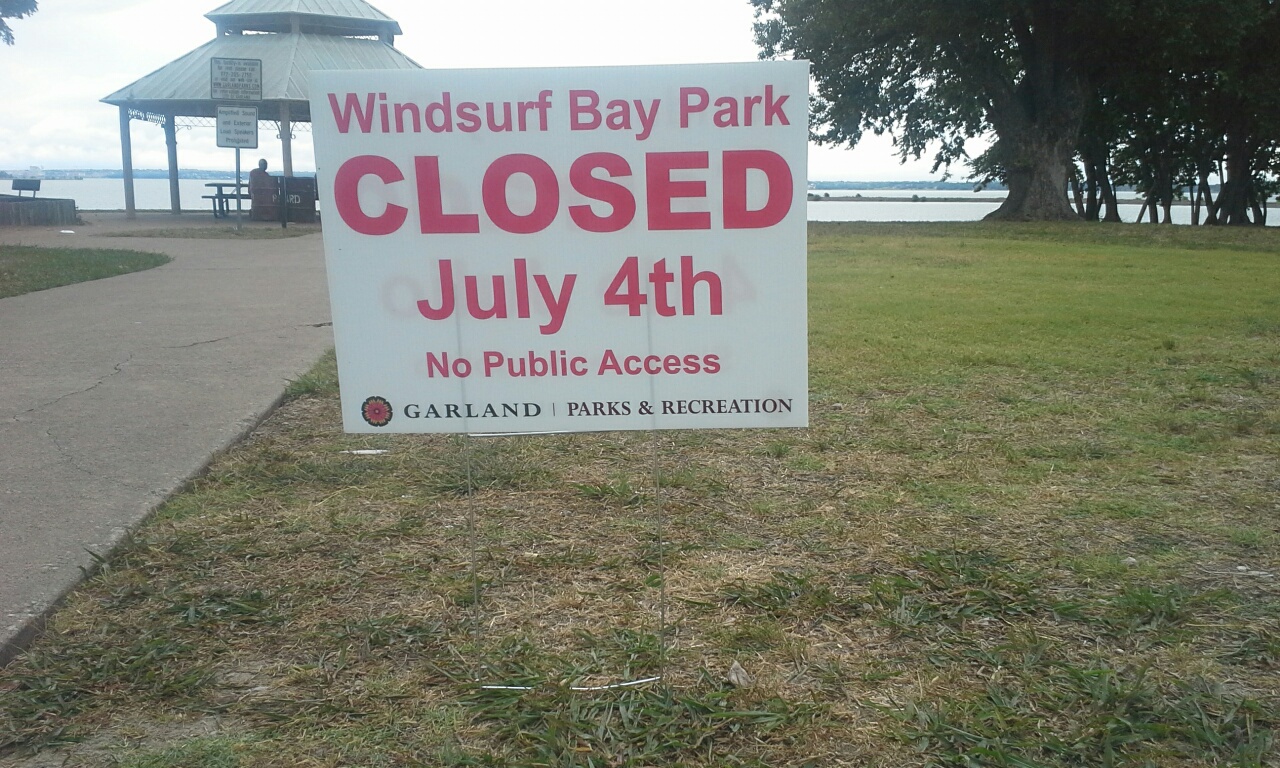
Garland City Council voted 8-1 on Tuesday night to close Windsurf Bay Park on this July 4 because the park was beyond successful on Independence Day 2017. The park abuts Lake Ray Hubbard and draws thousands from far and near.
Ignoring the signals regarding one of Garland's hidden jewels on July 4 is yet another example of a looming and potentially embarrassing crisis of poor planning that our city now faces.

If I could change only two things about our City of Garland municipal government, it would be to get it to spot problems faster and then react to them quicker and more creatively.

I was reminded of this Monday night as city council in work session discussed what to do about Garland's popular Windsurf Bay Park on the upcoming July 4 holiday. It was underscored even more so during the Tuesday-night regular council session on the same subject.

For nearly a year, city council has been warned that the Fourth of July last year at Windsurf Bay Park in Garland's southeast area abutting Lake Ray Hubbard was a mess and that the city needed to take proactive steps this year to avoid a potentially explosive situation.

Rather than study a whole range of possible positive options, the solution was a quick and easy negative decision to close the park on July 4 from midnight until 6 a.m. on July 5. Never mind that this "solution" carries with it another whole range of possible repercussions—many of which could end up tarnishing the city's image once again.
Windsurf Bay Park is one of the best-kept secrets and is a real jewel for our community. On the right is a bronze plaque noting the cooperating of the City of Garland and the State of Texas parks departments in establishing the park.
If something about this has a familiar ring to it, it should. Baylor Scott & White-Garland's closing went down the same path. Handwriting on the wall, handwriting on the wall, then bam! Garland has a potential crisis of mega proportions. Once again!

The controversy over Garland's 50-plus-year old animal shelter that has raged far and wide in recent weeks is another example of the city dragging its feet when positive action is needed.

According to Garland Police and city officials, the celebration of The Fourth at Windsurf Bay Park has grown in popularity in recent years so that people travel here from surrounding cities—and a few from out of state—to celebrate July 4 at our city park, which is almost totally lacking in good roads (they desperately need to be graded), adequate restrooms (nothing but a few portacans), and organized parking—all the things that are "supposed" to make a park more appealing.
A handful of portapotties can barely handle the daily visits from swimmers, fishermen, and picnic-ers to the park. No wonder it was such a mess last July 4 when thousands descended on our lovely park by the lake.
The crowd at the park last year was described as "in the thousands", with people doing all sorts of unacceptable things such as swimming in the lake without a lifeguard present, barbecuing along the shore line and dumping their used charcoal and ashes wherever they pleased, smoking marijuana and drinking beer and throwing their drink cans on the grass, illegally shooting off fireworks within city limits, and celebrating in overcrowded conditions so bad that emergency crews couldn't get through to them if, for instance, someone fainted from the heat or a firecracker burned someone else's hands.

Mercy me, it sounded a little like Woodstock back in 1969. Fortunately at least no one has described someone ripping off their clothes and running up and down the beach in their birthday suits!

The movie, Field of Dreams, made famous the expression, "If you build it, he will come." Our Garland parks department and the State of Texas parks department worked together to create this little gem. We built it. Now they come. And we want them to stay away this year because success outran lack of preparedness? That makes little sense to many of us.
The inscription on this bronze plaque says, "Windsurf Bay Park, a Texas Local Parks, Recreation and Open-Space Fund Project sponsored by the City of Garland (and) Texas Wildlife and Parks Department".
People from as far away as Louisiana and Oklahoma have discovered Windsurf Bay Park—something we've for years been begging Garlandites and non-Garlandites to do about our downtown area, our Firewheel Center, and other city hot spots. Discover us! Please pay attention to Garland; we really do have great things here!, has been the cry.

The "discovery" of Windsurf Bay Park wasn't supposed to happen. But after one trip through there in preparation for this blog, I can see why it did. It is truly one of Garland's hidden jewels. It's quite beautiful, appealing, and restful—all elements that a park should be.

The park did not appear to be on any city leader's radar screen or list of top priorities until last year after the last July 4 festivities. How the word spread far and wide about our little ole Windsurf Bay Park being so ripe for celebration on July 4, no one on city council or from city staff seems able to fully explain—or let alone comprehend. Apparently the grapevine mixed with the Internet is highly powerful. And maybe the intrigue of a little ruggedness and beach-like feel at the park added to its charm and appeal.

The situation is also akin to someone planning and building sidewalks, only later to observe that people were making their own walking trails in the grass. Sidewalk planners might have benefited from first observing the natural patterns.

Complicating matters further, no one on council or in our city government had ever conducted a "catalyst study"—our city's ideal of how local government should revive an area—specifically on the park itself or even thought about it being something that potentially could draw people into our city—and at the same time make this a more lively place to live.
This road is the only entrance into the lakeside park.
Until, of course, after Garland Police Chief Mitch Bates did what he had been told to do: arrive at Council Monday night with plans for shutting down Windsurf Bay Park on July 4 (with the potential of returning to ask the same thing on Labor Day, another high-use occasion) and telling those awful non-Garlandites to leave our fair city and take their money (that they might spend nearby) elsewhere.

That's right. The message the city is sending is, "Leave our park empty on July 4. And take your money with you as you go! (Never mind that you might use it to boost Garland's economy.) And don't come back unless we tell you that you can."

Not exactly the kind of welcome mat the city needs to be putting out anywhere!

Wednesday morning after the council vote, the city's parks department was posting signs throughout the park and at the entrance telling people, in English and Spanish, that the park would be closed on July 4. 

Apparently we'd rather have an empty park, a temporary city-funded $5,200 fence (with a potential $700 per month additional rental fee if the city decides it needs to continue), and police apparently on overtime guarding the fortress than to figure out what the "vibe" is that has these visitors find so enchanting in a tiny, relatively unknown but quaint spot in our city.

We certainly don't want the likes of these people from outside our borders using a facility in our fair City of Garland. Right? Certainly we don't want to "make lemonade out of lemons", now do we?

Fortunately, sanity began to take hold of the city council meeting Monday night. At first two city council members expressed dismay that the city would be closing the park on July 4 and had no alternative plan for the situation. Eventually some who at first seemed to be encouraging the closing started backtracking and started stating their desire to make the park better—after this July 4. By Tuesday night only one council member—Rich Aubin of District 5—stood firm against the closing of the "highly successful" park while the others voted for closure.

Some among the eight who voted "yes" to closure argued that the city really has no options, with the July 4 holiday bearing down us like a fast-moving freight train. Time is definitely NOT on the city's side now, they said. After seeing the park Wednesday morning, June 20, I'm not so sure. Setting it up properly now would be a tremendous challenge but not impossible. Where is Garland's old "can-do spirit"?

Meanwhile, I am still left with that gnawing question, "What will it take for our leaders to wake up and smell the coffee BEFORE bad things happen again in this city?"

When Baylor Scott & White abruptly closed our city's only full-service hospital on February 28, city leaders had been warned more than a year earlier (and the handwriting had been on the wall for nearly a decade—see my blog on 12/19/2017) this might happen, but our leaders lived in denial, believing that something or someone was going to rescue them.

Unfortunately, the story is not new for Garland. Wait! Hesitate! Look to old solutions and past formulas. And let's console ourselves with a pat on the hand that says "everything is going to be OK".

It will, won't it?

"Just be quiet and don't say anything and maybe, just maybe, our problems will go away" often seems to be our motto here.

Meanwhile, our sister cities to the east, north, and west, blossom and sizzle. And some of our council members get irked at anyone who dares to suggest we are NOT in that fast-moving group.

Instead of renting a fence to seal off the park and positioning Garland police officers and squad cars to ward off any problems at Windsurf Bay Park—once again risking negative publicity about our city—why wasn't a citizens committee formed earlier this year and filled with blue-ribbon creative types empowered to look for win-win inventive solutions? The good idea of possibly requiring advance reservations and capping the number of entrants, turning others away once a safe cap was reached, was proposed Monday night by a brand-new city councilperson, but it didn't get enough traction to keep the park open this year. (Chief Bates said from 7-8,000 guests used the park last year.) A citizens group created to study the Windsurf Bay dilemma could have hatched up ideas such as this much earlier so some solutions could have been in place well before this July 4 loomed upon everyone.
Next to the lake, with storm clouds rolling in, Windsurf Bay Park is a truly beautiful place. Its dirt/sand roads, however, could use a visit from a tractor with a sharp grader!
Parking problems? Did anyone ever consider utilizing the parking lots at several nearby churches or apartment complexes (apparently destroyed by the tornado) and providing shuttle service for park patrons, then charging them an entrance fee to the park to pay for the shuttle and extra security?

Maybe our annual visitors really don't know that they are not supposed to dump their used charcoal and ashes on the ground in our parks. That's not posted in the park-rules signs already in place at Windsurf Bay Park. (However, littering, shooting fireworks, drinking alcoholic beverages, etc. are already posted!)

On Tuesday night Aubin suggested signs stating that no lifeguard is on duty. On Wednesday people were swimming and fishing along the shoreline. If these signs are needed on July 4, they also are needed on other days of the year as well. Did anyone ever think of that before Tuesday night?

And the issue of people parking in the nearby neighborhood? Doesn't the city own hundreds (maybe thousands) of barricades—far more than enough to block off access to all those streets? (As a rough estimate, I would say less than 50 would be needed.) And couldn't we have asked our Citizens on Patrol to staff those barricades voluntarily?

Our leaders seem to function with the idea that there are no solutions, except the most narrow and limited ones from the past. I doubt most have ever heard the entrepreneur's heart-cry, "Seize the moment!"

Take, for instance, another hot-button topic in our city right now: our antiquated animal shelter. Ever since I drove to Plano's animal shelter years ago and rescued a castaway Bichon/Poodle for our daughter after earlier visiting Garland's animal shelter and finding no suitable pet for a person with severe cat-and-dog dander allergies, I've been concerned that Garland's animal shelter needs to be replaced with something much better, more adequate, and more modern. Even then I knew that Plano dazzles while Garland plods and falls further and further behind.

Now, of course, the city is once again put in a bad light because of all the unresolved issues at the animal shelter that were brought to the surface by the controversy generated by a persistent CITIZEN group—including, heaven forbid, an "outsider" from Dallas—not willing to settle for our status quo. A citizens task force immediately after the last mayoral election starting to work on planning a new animal shelter with an eye to upgrading services could have been well on the road to having a solution.

City council members can no longer hide behind some members' disdain for our former mayor as their excuse for not leading properly. They wasted far too much time voting against things just because they presumed the former mayor supported those issues. So now there's no one else to blame for their blunders or lack of leadership except themselves.

It's time for council to start becoming proactive instead of bureaucratic. Foot-dragging and being reactive need to become council practices of the past—not carried forth into the future.
Garland City Council was at a fork in the road regarding Windsurf Bay Park Monday night. These signs tell much about that dilemma.


Wednesday, June 6, 2018

Do we live in a democracy? In Garland city elections the democratic process is all but eliminated because of the powerful Garland Fire Fighters Association


My membership in the Citizens Fire Academy taught me the rigors Garland firefighters endure to perform their jobs well. Because I care about our firefighters, I believe the Garland Firefighters Association needs a mid-course correction in the way it involves itself during local elections.
Garland citizens need to have an important and necessary conversation about the role, power and influence of the Garland Fire Fighters Association and its political action committee in our city's elections.

Our city's fire department is NOT involved directly in our city's elections. Like all city departments, it is by law supposed to be nonpolitical. However, the independent union-like association that includes many of our firefighters is intricately involved in city politics—and in ways and to the extent that may surprise average voters and citizens of our community. The law requires this to be done out of uniform and totally off hours and away from their places of work.

At the same time, an Open Records request to the city proved what many have long suspected and rumored but, in typical Garland fashion, is not readily in public view: Less than 5% (a total of 6) of our 119 firefighters (people in our fire department who bear that job title) actually live and vote in Garland. The other 95% live as far away as southern Oklahoma, East Texas, the western outskirts of Fort Worth and other places. The firefighters earn between $61,084 and $76,760 a year in Garland and from Garland citizens' pockets yet spend the vast majority of that money in other places, building the economic base of other locations. 

While 95% of our actual firefighters live outside the City of Garland, do not pay taxes here, and do not vote in our city, the firefighters association, which touts loudly and proudly "Garland Firefighters support . . .", exercises perhaps the most powerful influence of any individual or group over our city's municipal government. 

Before I go further in this blog, let me be clear: I love and respect our city's and our nation's first-responders, including the brave men and women who keep us safe when fire turns destructive. I am a proud graduate of the City of Garland's Citizens Fire Academy; I am a member of the Citizens Firefighters Club of Garland. Two of my four nephews are firefighters in Oklahoma. One of Kay's cousins is a firefighter in Dallas; another is retired from the volunteer fire department in a small town in East Texas. We have friends who are parents of firefighters. At our house we love firefighters as individuals and as a department of our city!

I also love Garland and our city's firefighters enough to ask the difficult questions about their political action committee, their union leaders, and their excessive over-involvement in our city's political elections. I want better for them and don't want to see them continuing to go down a troublesome path many in our city are beginning to seriously question and which could majorly damage our fire department's reputation overall.
I cherish my experience as a member of the Garland Citizens Fire Academy, where I and my fellow class members learned a bit of what goes into a firefighter's workday. Regretfully only 6 of Garland's firefighters (less than 5 percent) live in Garland, yet the union of which many are members makes far-reaching decisions that will impact our city's citizens for decades.
I would ask the same questions if another group—for instance, employees of the Garland Environmental Waste Services or the city's Streets Department—has a PAC and conducted themselves in this manner. Regular city employees also are by law under the same restrictions about campaigning and being involved in municipal elections as are the fire and police employees. They may not use their positions to directly influence a campaign or election.

This is also not meant to reflect personally on the candidates that the political action committee endorsed in the most recent city election. Because of the way this firefighters' PAC operates, however, the election was not a fair fight—and local elections down the road can never be a fair fight as long as this organization's practices are not seriously studied or countered.

To counterbalance the excessive power the Garland Fire Fighters Association wields in our city elections, other groups of city employees, disenfranchised residents, or others may be forced to rise up to challenge the GFFA-dominated power structure here. I heard grumblings of this during the recent Mayor of Garland campaign.

The way the Garland Fire Fighters Association's PAC operates creates the type of municipal election here that essentially eliminates the democratic process. Only a candidate endorsed by the PAC has any chance of winning at all, given the deep pockets the firefighters' union has. In this blog I repeatedly have encouraged Garland citizens to run for public office and to throw their hats in the ring in local elections and to exercise their rights as citizens to do so. However, very few people can stand against this kind of onslaught. The average citizen can't expect to take on this challenge unless the person is independently wealthy and can outspend the deep-pocketed Garland Fire Fighters Association union. Even at that, there's no guarantee, because who is going to oppose the "motherhood-and-apple-pie" questionable approach of "Hi, I'm a Garland firefighter" or "Hi, I'm a firefighter" that occurs when GFFA representatives electioneer at polling places and approach voters with their endorsements and materials as they enter to cast their ballots? It represents an extremely unfair advantage. It has earmarks of what one might experience if he or she lived in a country where there is really no choice in an election or where successors are pre-selected.

Let's first define three terms that are crucial to this conversation. The terms sound alike but legally apply to three different entities.

1. The Garland Fire Department. This is the unit of our city assigned to save lives and property by fighting fires and transporting and sick and injured to area medical facilities. It is top quality with an annual operating budget of $32,635,109 for fiscal year 2017-2018. The city employs 119 firefighters and 141 others in that department. Mark Lee is the city's fire chief.

2. The Garland Fire Fighters Association. This AFL-CIO affiliated organization is known as the International Organization of Fire Fighters Local 1293. While a separate entity from the Garland Fire Department, its membership is overlapping and is composed of most of the men and women in the Garland Fire Department, not just "firefighters" per se.

3. The Garland Fire Fighters Community Interest Committee is a political action committee, aka a PAC. It is somewhat similar to those PAC's you read about in national elections, which are funded by extremely rich U.S. citizens who often have right-wing, left-wing, and other political agendas. The local Garland PAC pools money given by firefighters (often deducted directly from their city paychecks) to be used in political activities, such as elections for Garland city council and mayoral races. Many Garland politicos believe it is almost next to impossible for an ordinary citizen in a competitive race against a council or mayoral candidate endorsed by Local 1293 to win. Because the group is so well organized, skilled, monetarily endowed, and powerful, the Firefighter PAC is able to throw as much money and influence as necessary to win an election here.

The Fire Fighters Association even has its own private offices in the basement of the Chase Bank Building near the intersection of Garland Avenue at Main Street.

Garland firefighter David Riggs, president for many years of the association, and Garland firefighter Brandon Day, secretary-treasurer, are key leaders in the organization and the organization's political campaigns. Riggs is a skilled, seasoned politician who is scheduled to retire from the Garland Fire Department in 2019. I will be very surprised if he doesn't opt to run for public office in coming years or create his own consulting business for political candidates. Riggs lists on State of Texas paperwork his address as Sulphur Springs, TX. He is among Garland's most astute political powerhouses right now and one of the most influential people in Garland city elections, even though his address is in Sulphur Springs.
A familiar face in matters pertaining to Garland politics is David Riggs, president of the Garland Fire Fighters Association, and one of the most powerful political figures in Garland.
During the most recent election, Riggs worked tirelessly for his candidates, not only ordering, paying for with PAC funds, and putting up their campaign signs and orchestrating multiple targeted mailings and robo phone calls but even bringing meals to them and delivering and taking other actions at their beck and call.

The Garland Fire Fighters Association's Community Interest Committee is the strongest and most financially able of any PAC in Garland today. It makes the other Garland PAC's associated with such entities as the Republicans and Democrats in our community look weak and anemic.

The only comparable Garland entity to the firefighters is the UA Plumbers and Pipefitter Union Local PAC Fund, which gives mostly to non-local races. It does not seem to want or have an influence in our city's politics. Its focus seems to be on state and national politics.

So the firefighters' PAC stands alone in financial strength and political power in our city. Nothing else in Garland compares to it. No wonder our local politicians appear to live in awe—and at the same time fear—of it!

One has to follow the rabbit-trail through state government maze at the Texas Ethics Commission's website to discern the true wealth and influence of the Garland Fire Fighters Association and its powerful PAC, aka the association's Community Interest Committee.

Fortunately, the State of Texas requires the PAC to file paperwork for its fundraising and expenditures on political campaigns. This is yet another classic example of how the state appropriately has to supervise what goes on in a city.

The role of the Garland Fire Fighters Association's Community Interest Committee is especially significant in a city where voter apathy is extreme and financial means for elections is desperately small. Those unfortunate elements combine to magnify the influence of the firefighters' PAC. (In the last election only about 3% of Garland voters exercised their right to vote.)

The Garland Fire Fighters Community Interest Committee has the financial resources and political clout in the city to elect just about whoever it wants in a city election. And when it deems necessary, the PAC uses those resources to whatever extent necessary, leading to what could make a significant portion of our current Garland City Council beholden to it, living in fear of it, or going begging after its support.

The city has little it can do to cure the union's influence, especially since the majority of the members of the Garland City Council were elected with its help—and three of the others have never stood for election and received even one citizen's actual vote and easily could live wondering what would happen to them if they ever became involved in a REAL contested election and needed the firefighter PAC's assistance to stay in office.

It represents an extremely unfair advantage, especially when those approaching the voter with the appealing introduction, "Hi, I'm a firefighter”, fail to reveal their actual place of residency elsewhere. Members of the Garland Fire Fighters Association say they perform these election-related tasks in their off-duty hours. One told a member of our campaign staff that he was paid by PAC money to be present at the polls. (Initial reports filed in Austin indicate the firefighters who work the poll are paid by the PAC. More on this in another blog later.)

And why not live in Garland? If firefighters and other city employees work here and earn their salaries here, why would they not want to support the hand that feeds them and help bolster the economic base that in turn could help their lot economically? Garland has nice homes, wonderful people, good schools, and a city with an economic base that needs all the help it can muster! If our city council had courage, it would ask important questions like that when the union leaders come calling asking for their pet projects such as setting up a special "retirement stability benefit" for them.

In late 2017, the Garland Fire Fighters Association's Community Interest Committee reported to the State of Texas that it had available assets of more than $120,000 and was still collecting funds to disperse during elections in 2018 and beyond. (In Garland, a contested City Council race can cost upward of $10,000 and a mayoral election more than $50,000.) I personally ran a frugal mayoral campaign that spent more in the realm of what candidates for council normally spend (when a contested race actually occurs!) In its May 3 filing, the Garland firefighters PAC reported that for the year its receipts reached $33,228.00 and its expenditures $34,494.29. Those funds seem to have been disbursed mostly for Texas legislative races. Most of the expenses for its involvement in the Mayor of Garland special election on May 5 are not included in that May 3 report. I will report to my readers on them later when all those reports are filed and publicly available.

A major issue that Garland faces, as one reader pointed out recently in a response to one of my blogs, is that Garland does not have its own independent newspaper or other media such as TV or radio stations to help ferret out the truth for us. That means we have no independent voice in the community to determine and assess the information about city elections, including information about the oversized role of the firefighters association and its PAC.

During the most recent city election, one couldn't readily tell the difference between the city's fire department and the firefighters association and the activities of its PAC. Many citizens were quite confused by the distinction. Representatives of the Association hustled voters at the polling stations and identified themselves as "Hi, I'm a Garland firefighter" or  "Hi, I'm a firefighter", further muddying the waters between politically active city employees under the guise of the firefighters PAC and city practice restricting political activity of its employees.

I have asked the Texas Ethics Commission in Austin, the state's watchdog on elections, for a reading on just how close the association came to stepping over the fine legal line of what is ethically right for it and at the same time harmful to our citizens who want to do right in elections.
Texas law is very specific about what political signs can say and how wording is presented. Our campaign noted several areas needing clarification in the Garland Fire Fighters Association's signs.

Some of the PAC's larger campaign signs during the Mayor of Garland race need clarification about whether they could have violated the law. In my document filed with the Texas Ethics Commission in Austin I cite several potential areas of question with their signs. My campaign workers and I deliberately acted cautiously and opted to wait until after the election was over rather than sending the mayoral campaign into chaos by deliberately and legally raising the issue and demanding during the waning days of the campaign that the Garland Fire Fighters Association's possibly illegal signs be removed.

Now that the campaign is over, I believe the city must face up to and address the matter publicly, so that citizens understand fully how their votes are being influenced by the firefighters' PAC, its money, and what citizens' options are going forward for dealing with it.

Many Garland citizens approached, emailed, and or called me to complain about "the firefighters'" aggressive behavior, including numerous robo phone calls, excessive direct mailings, signs, and electioneering voters at the polls. All this went well beyond the mere act of issuing an endorsement for a candidate. Most citizens didn't seem to know the fine points that distinguish the city fire department, the independent association, and the powerful PAC. They just referred to what was happening in the election and at the polls as "the firefighters".

Our firefighters rightfully bemoan the higher cancer risk firefighters face today due to chemicals used in all sorts of manufacturing. And they have asked City Council for a special "retirement stability benefit" to help offset that danger—a perk that even our police who daily face untold dangers said was not a priority for them. Yet the firefighters association spends on city political campaigns vast sums of money that could be used for a more worthwhile cause such as care of firefighters battling cancer or maybe even special cancer insurance for them. An individual fire department employee could funnel his or her funds now going to the PAC and reallocate them into a savings account for his or her retirement, if that is a matter of concern. The association's and PAC's stewardship of these funds seems puzzling at best. For the past decade, they've been growing in their involvement with our city politics. In fact, many sitting city council members (those that were actually elected by citizens in a competitive race, not by council because no one filed against them) are in their debt for the money the organization has fed into their campaigns to get elected.

During the most recent mayoral election, the firefighters association seemed almost in a state of panic to make sure their candidate won. It reminded me of my classes in the Fire Academy in which we were taught to go into a fire using everything we had to put it out and not let it spread. The Garland Fire Fighters Association already had an outstanding track record for steering elections in their preferred direction, so their response in this election was more than noteworthy. 

The issue is NOT our valued firefighters individually nor as a department of the city. It is the element within the firefighters community that tries to exercise unfair political influence far beyond that which most people truly understand or believe is right in our nation.

Whether the group's actions are ethical, moral, or right—and should be allowed to continue unchallenged—is the question that Garland's citizens need to answer for themselves—after getting all the facts out in front of them, something that hasn't been done until now.

Like the proverbial "elephant in the living room", Garland politicos and wannabe politicos have much they need to tell our citizens and the public in general about the influence this group of city employees has over City Council and the city itself. What exactly is the firefighters association and its PAC being promised in exchange for its money and support at the polls? I suggest that every local candidate who has accepted firefighter PAC money publicly disclose the exact amount and how it was used, since the public seldom if ever reads the candidates' city-required campaign financial statements.

One antidote for the issue is to encourage other groups of employees and citizens to do the same as the firefighters association. If the firefighters association is allowed to continue to be so active in city politics, why not encourage every city department (engineering, animal control, library, waste management, et al) to form its own political action committee (PAC), to raise funds through withdrawals from their city paychecks and lobby for whatever monies or issues they desire?

For the sake of future candidates in all Garland elections—and certainly for the well-being of Garland firefighters themselves—this matter needs to be out in the open, freely discussed, and solutions sought. It's not fair to others in the city that one group gets to exercise power so much greater than other groups, especially since members of that power-wielding group are city employees, mostly do not live in our city, do not pay taxes as the rest of us are required to do, and do not vote in our city elections. They take Garland taxpayers' money and spend it in other locales, while wielding major influence that impacts our city for years and years to come.

Free access to our city's political system is part of building a better community for ALL Garland citizens.